Well, a short update. I managed to pass the CCIE Service Provider lab exam on March 14th.
I am quite exhausted from the experience, but very happy 🙂
With the release of the IOS XRv router, along with CSR (Cloud Services Router), its time that I go ahead and build myself a virtualization solution.
To that effect, I have just ordered the components for a home build server, which was the cheapest, not to mention most silent option available.
Its been a long time since my last update. I apologise for this. It wasnt my intention, it just sort of happened.
In the meantime I have tried the CCIE SP lab and didnt pass it, so I am still studying for my next attempt which is comming up shortly.
The CSNP (Complete Sequence Number PDU) on multi-access networks is being sent out on behalf of the DIS (Designated Intermediate System), which acts as the pseudonode representing the multi-access network. Its being used as ISIS’s way of making sure everybody on the multi-access network is up to date. If thats not the case, the node which is missing some routing information can use PSNP (Partial Sequence Number PDU)’s to request the missing information from the DIS.
In this short post i want to try and shed some light on a couple of ISIS timers that had me confused at first. I think i got them down now, but please let me know if i have misunderstood them.
In this post i would like to explain how you can fix a multicast RPF failure using BGP.
If you take a look at the topology in figure 1, we have a network running EIGRP as the IGP
and where R1 advertises its loopback 0 (1.1.1.1/32). R4 also has a loopback 0 with the 4.4.4.4/32 address.
This morning I booked my first go with the CCIE Service Provider lab exam. The battle is in mid November, so I have some time to study.
That also means that alot of forthcomming blog posts will be about CCIE SP material.
NTP has always been one of those things I have found tricky to really lab up. Its fairly easy to setup, but verifying whether everything is working as you expect, can be hard because it takes a while to synchronize (and even unsynchronize).
I have been very quiet when it comes to the topic of SDN (Software Defined Networking). However, these days you can hardly go through your day without spotting an article about it.
The reason I have been quiet is pretty simple. I wanted to understand it a bit better before writing anything about it.
Some very smart people have created a new website aimed at the career aspects of the tech world.
In time the site should prove to be a valuable tool for anyone trying to land a job in the tech industry.
I just had a chance to go ahead and read Mr. Greg Ferro’s ebook called ”Arse First Method of Technical Blogging“.
The book is being published by Leanpub (leanpub.com), an independent publisher and the readers will get free updates to the book as they become available.
In this post i would like to explain the usage of the “MPLS VPN Per VRF Label” feature.
By default, in each VRF, prefixes are assigned a VPN label, used to identify the route within the VRF itself.
This label is the only label that is being looked at by the receiving PE router.
I just ordered my ticket for DKNOG, which will be happening on March 21st in Copenhagen.
Catch me there if you can!
Wow. The other day, someone posted a link to [zenhabits.net]. and I was hooked right away.
The entire idea around being “Zen’ish” really appeals to me on a fundamental level. I like the idea behind it, i like what it entails, i like the discipline and i like the calmness.
Yesterday it was announced that Belkin intends to purchase the Linksys division of Cisco’s hands.
I for one, am very happy to see this happen.
I think that for Cisco to be really great, it needs to focus on its core competencies, which does not include home networking equipment.
Yesterday brought with it another Java security breach. It is security breach that doesnt yet have a fix for it (0-day), so short of disabling Java on your computer, you are out of luck.
Im continually amazed that we keep running this piece of software, but I guess I shouldnt be, given people’s track record of running insecure software (think older Internet Explorer browsers on windows).
“All that matters, is where you are going” is a favorite quote of mine.
With that an update as well as a plan to move forward.
I have now finished Narbik’s Volume 2 Service Provider workbook. It took a little while longer than I had planned. This is mainly because i took some time off during the holidays (well, studied less at least 🙂 ).
I have now finished the Narbik Volume 1 labs.
It took about 2,5 weeks to do. Im planning on spending a bit more time on the Volume 2 labs. Maybe about 3-4 weeks. I want to make sure i got all the foundational stuff down before advancing to some more complex labs.
In this short piece i would like to show how Frame-Relay PVC bundles work.
A PVC bundle is exactly what the name says. Its a bundle of PVC’s, with each PVC handling a certain Precedence, MPLS EXP or DSCP.
A requirement for the PVC bundle is that all IP Precedence or DSCP values will be handled by one of the PVC’s, so you need to set the “default” PVC unless
Just wanted to let you know of a good place to go for some IOS-XR training.
Head on over to FryGuy’s place:
http://www.fryguy.net/2012/11/06/ios-xr-cisco-videos-and-training/
Just wanted to share another great motivational video
I have recertified by doing the SP written exam.
Took me a while, but now its done.
My plan is to hit the labs, starting with Narbik’s SP workbook, working my way through that one. That should keep me occupied for quite a while.
In this post i would like to demonstrate the Class-Based Tunnel Selection feature.
In class-based tunnel selection, we will select an MPLS TE tunnel based on the incomming Precedence bit in the data.
For example, IP Prec 5 goes to TE Tunnel 1, whereas IP Prec 3 goes to TE Tunnel 2.
In this post i would like to demonstrate the concept of a well known MPLS TE (Traffic Engineering) feature, known as Fast Reroute.
Fast Reroute, as the name implies, is used to create an MPLS network, that has similar convergence properties of SONET/SDH APS of about 50 ms.
Sorry for the lack of contents lately.
I am dealing with some personal issues that put a bit of a pause to my studies.
As soon as I’m fit for it I will put up some stuff related to the SP space.
Today I came across a blog post from a guy which I respect deeply. However, I disagree wholeheartedly with the content in the post.
The title says: “That Setting Yourself Goals is Practising Failure” and the entire post can be found here.
I apologize for the recent down-time.
My provider had a glitch which is hopefully fixed now.
I ran into this error today on an old ASA and i needed a quick fix that didnt involve downgrading any Java versions from the clients servers.
I can confirm that by using version 6.1(5)51 of the ASDM works correctly (as noted in the link below).
I think the video below is worth going through for a couple of reasons.
First off, it explains one networking company’s strategy towards SDN (Software Defined Networking). Its a great academic concept with lots of potential. However there’s no real push for it from customers (at least the customer base of Arista).
One of the cool things about MPLS is its versatility.
In this post i will show how its possible for a service provider to support legacy frame-relay installations without actually having any frame-relay switches.
I will establish an MPLS core and show how a customer with three sites, one hub site and two spoke sites, will never even know that the core is running MPLS and not end-to-end frame-relay.
I have ordered the first batch of books for the CCIE SP track.
They are:
I was hoping that you could get them all as eBooks, but as it turns out, i can get some of them as eBooks through Kindle and some through Cisco Press PDF’s and others i could only get as hard copies. This is not the ideal solution.
The cat is out of the bag.
I am going for my 2nd CCIE. This time its in the Service Provider track.
For a while i have felt something missing. And what is missing is a clear cut direction on what i want to learn more about in my professional life.
I think one of the most important things this to happen this week, was a public announcement
from the boss of TeliaSonera.
He announced that they would in the near future, start to charge people for any VoIP calls they would make through their broadband services.
Its been a rough week. I have been finishing up projects and getting rid of loose ends.
I have also been giving a couple of lectures on IPv6 (Basically primers) to customers as well as some information on basic failover configuration in IOS. The advent of 3G and low cost gives alot of new opportunities for customers.
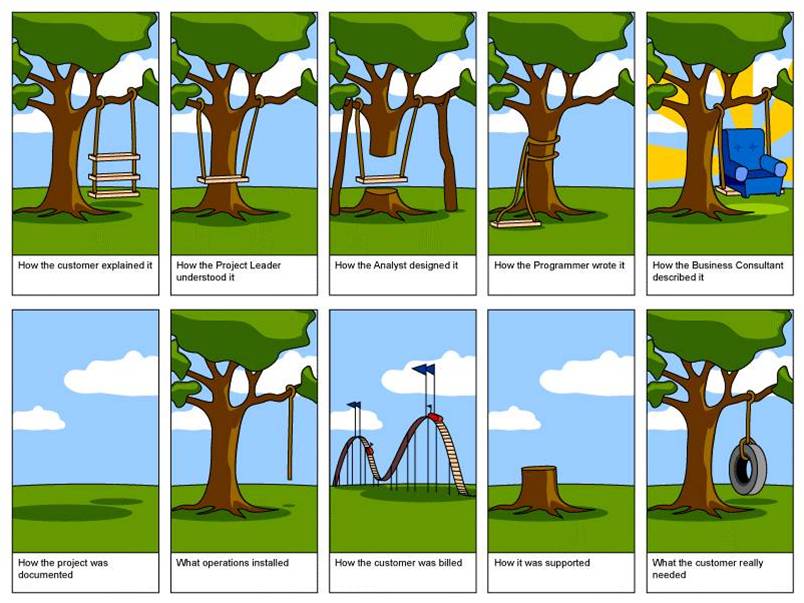
The picture below should be put into a frame and put onto the desk of everyone in the IT industry.
By day, I am a consultant, so I have quite a few stories that relate to this picture.
Below are my findings regarding CAR. Please be advised that this is work in progress.
CAR is the ancient way of doing policing.
It is not configured using any of the new and fancy MQC style configuration.
It is an interface-based command set.
A couple of things i have found interesting this week.
The first one is that Intel is still in the game for making NIC’s. Even though they are doing some good ones in the server space, this batch seems to be targeted at the entry-level.
We are working with alot of customers having lots of small “sites”, meaning that each site range from having 1 to 20 devices. The devices can be a user workstation or it can be some sort of automatic equipment having a VPN tunnel back to the main headquarter.
Finally.
I have been using Things as my task management program for about 5-6 months.
Its been better than not using anything at all, but what has really annoyed me quite heavily is its inability to do “Cloud” synchronization. The only form of synchronization from Things is through your wireless network. And even so, just directly to your Mac, which then syncs to the other devices.